Title: AMD Radeon RX 9070 XT Review: A Game-Changer for 4K Gamers at an Affordable Price
AMD has been trying to compete with Nvidia at the high end for the past few generations, but with the Radeon RX 9070 XT, Team Red has shifted its focus. Instead of targeting the ultra-high-end market dominated by the RTX 5090, AMD has crafted a graphics card aimed squarely at the majority of gamers. The result is a $599 GPU that is poised to redefine value in the 4K gaming market.

A New Era for Mid-Range GPUs
The AMD Radeon RX 9070 XT is positioned as a direct competitor to Nvidia’s $749 GeForce RTX 5070 Ti. Despite the price difference, AMD’s offering delivers excellent performance, making it one of the best GPUs on the market. What makes it stand out is the introduction of FidelityFX Super Resolution 4 (FSR 4), AMD’s AI-powered upscaling technology, which brings the company’s graphics cards on par with Nvidia’s DLSS.
Powerful Specs and Features
Built on the RDNA 4 architecture, the Radeon RX 9070 XT features significant improvements, particularly in its new RT (Ray Tracing) and AI Accelerators. The AI Accelerators are crucial for enabling FSR 4, which provides more accurate image upscaling compared to its predecessor, FSR 3.1. While the performance impact of FSR 4 is noticeable, its enhanced image quality—especially in texture-rich areas like grass or in-game text—is a welcome trade-off for gamers who prioritize visual fidelity.
The 9070 XT features 64 Compute Units, a notable improvement over the 7900 XT’s 84 Compute Units, but the result is still a generational leap in performance. Each Compute Unit is equipped with 64 Streaming Multiprocessors (SMs), totaling 4,096. Additionally, the card has 64 ray accelerators and 128 AI accelerators, ensuring it handles both ray tracing and AI-based tasks efficiently.
However, the RX 9070 XT comes with 16GB of GDDR6 memory, down from the 20GB of GDDR6 on the 7900 XT. While this reduction in memory capacity and bandwidth (due to the 256-bit memory bus) is noticeable, it’s still more than sufficient for most 4K gaming scenarios. AMD’s use of GDDR6 rather than faster alternatives might have been a potential downside, but the performance still holds up remarkably well.

Energy Efficiency and Cooling
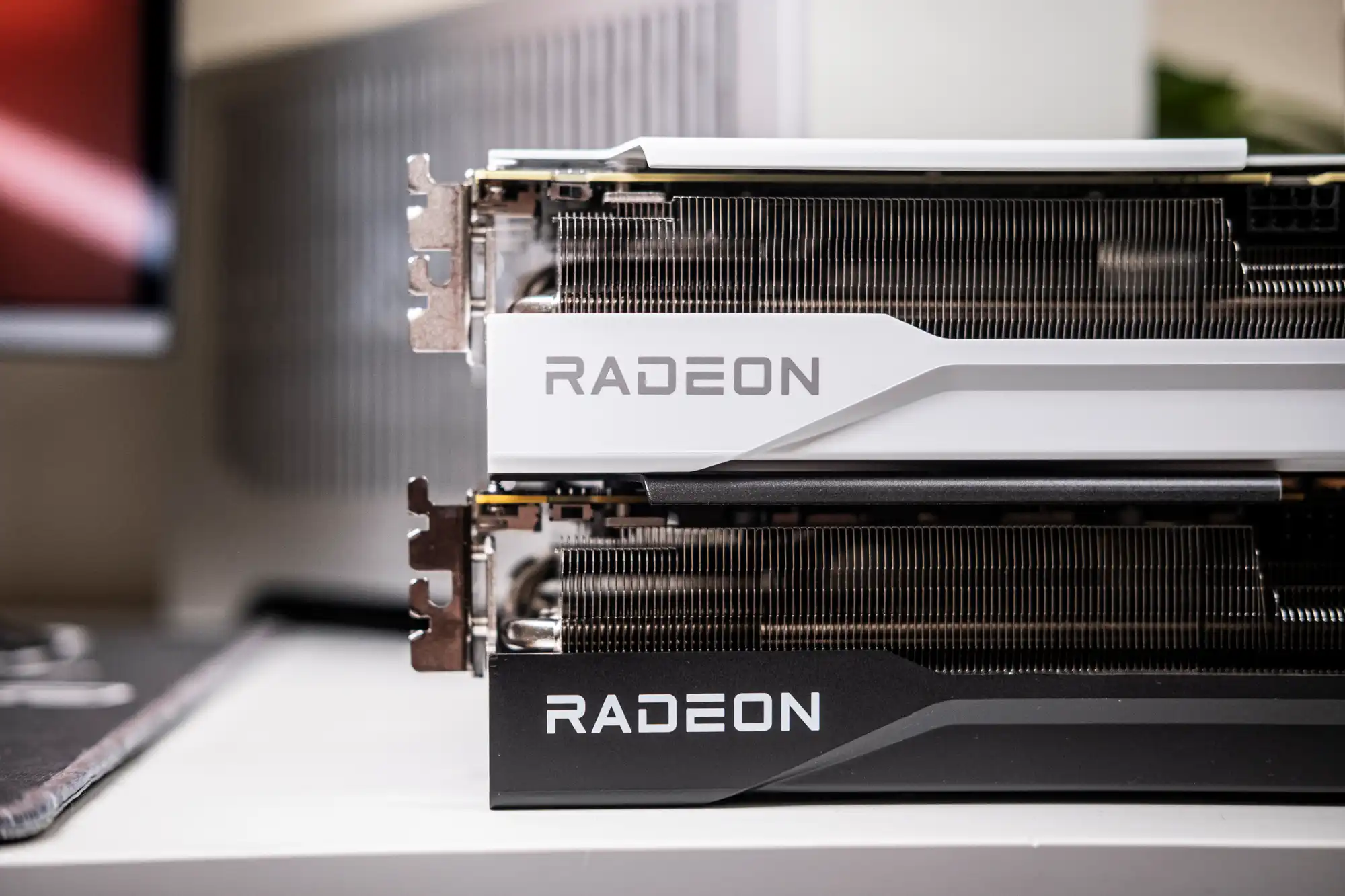
The 9070 XT requires a 304W power supply, slightly more than the 7900 XT’s 300W, though in practical testing, power consumption was almost identical between the two cards. Despite this, cooling is not a concern; the review unit I received, the Powercolor Radeon RX 9070 XT Reaper, performed admirably with a compact triple-fan design that kept temperatures at a comfortable 72°C during testing.
The Radeon RX 9070 XT utilizes two 8-pin PCI-E power connectors and requires a 700W power supply, making it an easy upgrade for most systems. It also comes equipped with three DisplayPort 2.1a outputs and one HDMI 2.1b port, ensuring compatibility with a wide range of displays. However, a USB-C port would have been a nice addition for greater flexibility.
FSR 4: AMD’s Answer to DLSS
FSR 4 is arguably the highlight of the Radeon RX 9070 XT. For years, AMD’s FidelityFX Super Resolution has been a solid option for upscaling, but it was often criticized for ghosting and image fuzziness. FSR 4, powered by AI, fixes these issues, providing better image quality by analyzing previous frames and upscaling lower-resolution images with greater accuracy.
In tests, FSR 4 does result in a performance drop, but the image quality improvement is substantial. For instance, in Call of Duty: Black Ops 6 at 4K extreme settings, FSR 4 led to a 10% drop in frame rates, from 134 fps with FSR 3.1 to 121 fps. Similarly, in Monster Hunter Wilds, the drop was about 20%, from 94 fps to 78 fps at 4K with both FSR 3 and ray tracing enabled. AMD acknowledges this performance hit, but the trade-off is worth it for gamers who care more about visual fidelity than raw performance.
A Balanced, Affordable Solution
The AMD Radeon RX 9070 XT represents a significant leap forward for AMD in the mid-range GPU market. At $599, it offers a compelling alternative to Nvidia’s offerings, delivering solid performance, impressive AI-based upscaling, and efficient cooling. While there is a performance drop when enabling FSR 4, the visual enhancements make it an attractive option for gamers who prefer stunning image quality without breaking the bank on ultra-high-end cards.
Ultimately, the RX 9070 XT is the graphics card to get for 4K gaming on a budget. If you’re not ready to drop $1,999 on an RTX 5090 but still want a top-tier experience, this is the card for you.
About the Author