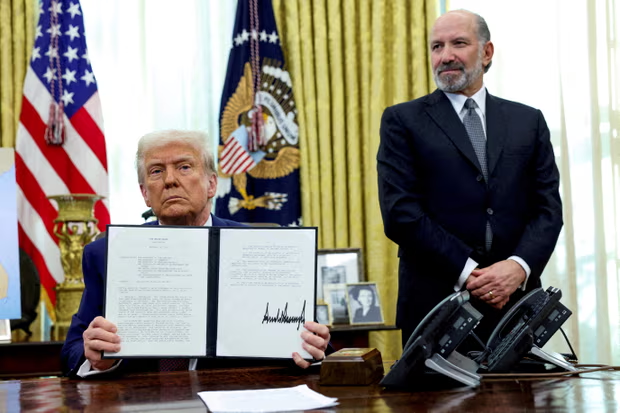
US President Donald Trump has signed an executive order aimed at dismantling the Department of Education, fulfilling a major campaign promise and a long-held objective of conservative lawmakers. Citing the agency’s “staggering failures,” Trump pledged to return control of education funding to individual states.
“We’re going to shut it down as quickly as possible,” Trump stated during the signing ceremony at the White House. However, his administration acknowledged that a complete closure of the department would require Congressional approval.
Legal Hurdles and Opposition
The executive order faces immediate legal challenges from opponents seeking to block the agency’s closure and the sweeping job cuts announced earlier this week. Dismantling the department outright remains a complex process, as Congress holds the power to approve or reject such a move.
At the signing event, Trump, surrounded by schoolchildren seated at desks, emphasized that the United States spends more on education than any other nation yet lags in student performance. His administration intends to reduce the scope of the department within the limits of executive authority.
Reshaping the Education System
The order directs Education Secretary Linda McMahon to initiate steps to transfer authority over education matters to state and local governments. Trump expressed his hope that McMahon would be the department’s final secretary, stating he would assign her a new role within his administration if the plan succeeds.
Louisiana Senator Bill Cassidy, a Republican, announced plans to introduce legislation to formally shut down the department. However, with Republicans holding only a slim 53-47 majority in the Senate, achieving the required 60 votes remains an uphill battle.
Even if full closure is not achieved, experts predict that the Trump administration could significantly reduce the department’s funding and workforce, as it has done with other federal agencies like USAID. Such measures could drastically alter the department’s operations and responsibilities.
Impact on Student Loans and Federal Education Programs
Established in 1979, the Department of Education administers student loans and funds programs designed to support low-income students. Trump has accused the agency of promoting political and ideological biases in schools. However, the department does not directly control school curricula, which are set at state and local levels.

While federal funding comprises only about 13% of primary and secondary education budgets, the department plays a key role in overseeing student loan programs. The executive order leaves questions unanswered regarding the future of these programs, with some speculating that responsibilities may be transferred to the Treasury Department.
Backlash from Educators and Advocacy Groups
Trump’s decision has sparked criticism from educators and advocacy organizations. The American Federation of Teachers condemned the move, stating that while bureaucratic reform is welcome, dismantling the department would disproportionately harm children living in poverty and those with disabilities.
Meanwhile, the administration’s broader efforts to shrink the federal workforce continue. The Department of Government Efficiency (Doge), led by billionaire Elon Musk, has announced that nearly 2,100 Education Department employees will be placed on leave starting Friday.
A Conservative Dream Revived
For more than four decades, conservative lawmakers have called for the abolition of the Department of Education. In 1981, President Ronald Reagan first proposed eliminating the agency, arguing that education should be a state and local responsibility.
As Trump pushes forward with his plans, legal battles and legislative hurdles will determine whether he can achieve what previous Republican presidents could not—dismantling the Department of Education once and for all.
About the Author